Guides · Clermont, Florida
Clermont FL History: From Citrus Groves to Sports Hub
Clermont was founded on citrus. Now it's known for hills, a tower, and the athletes who train on them. The groves that built the town are mostly gone, but the landscape they left behind—and the landmark built to celebrate them—still defines the place.
How Citrus Built Clermont and Why It Collapsed
Clermont's citrus economy didn't just dominate the town; it dominated the entire county. Orange groves covered the rolling hills, and for the first half of the twentieth century, that was the whole game. Established in 1884 and incorporated as a town on 9 June 1891, Clermont grew because the land was good for citrus and the railroad could get it to market. The town's very name came from the French hometown of A.F. Wrotnowski, the manager of the Clermont Improvement Company—a land and development operation built around the promise of agriculture.
Then the freezes came. Repeated hard freezes in the latter half of the twentieth century hammered the groves, and suburban development finished the job. The citrus economy didn't just shrink; it collapsed, and fast. By the time the industry faded, the hills that had once been green with trees were being scraped flat for subdivisions. The county's economy had to find something else, which is a problem when your only industry was oranges.
Florida Citrus Tower: A Landmark That Survived the Industry
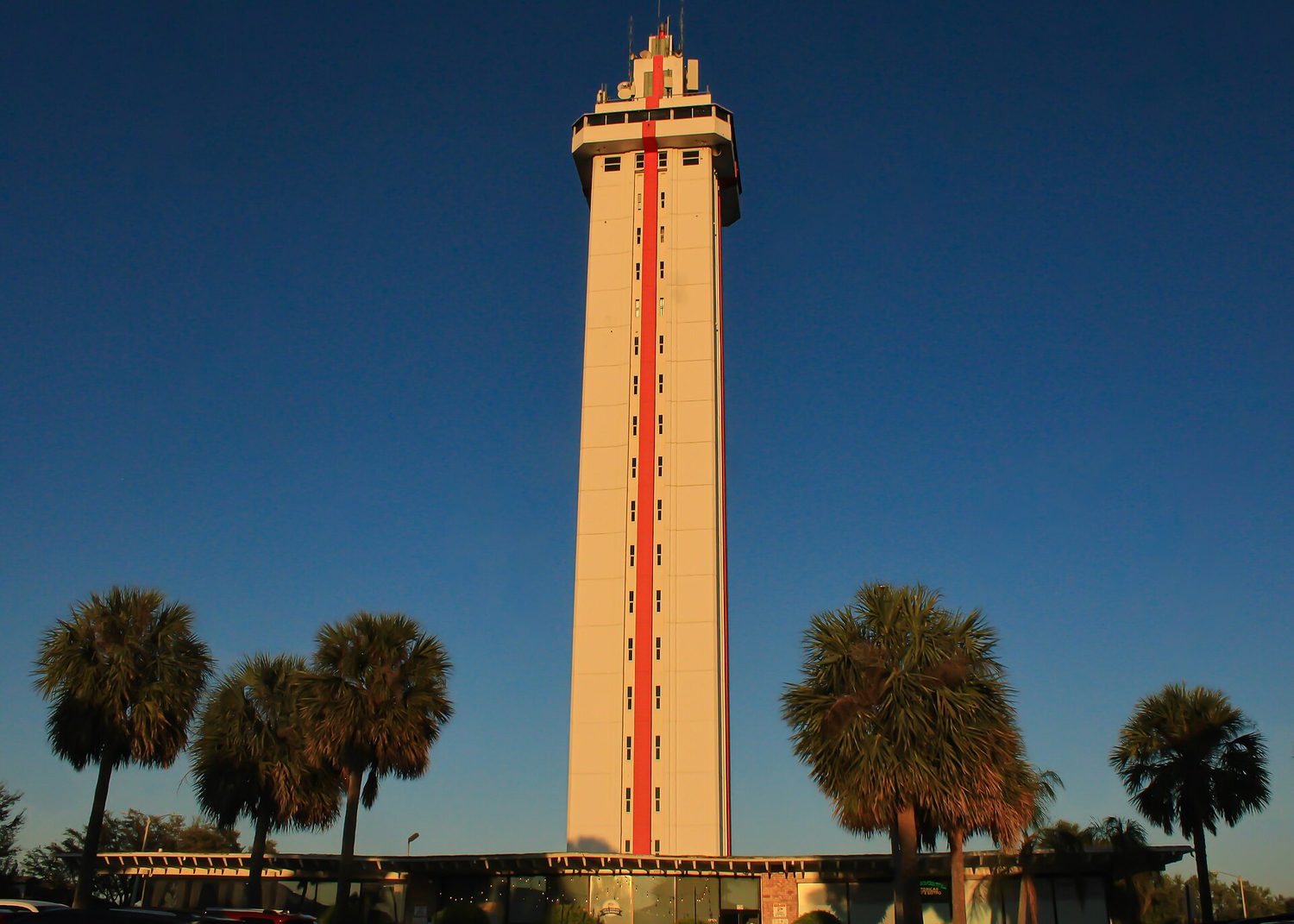
The Florida Citrus Tower was built in 1956, at the peak of citrus confidence. It was one of Florida's earliest roadside landmarks, a 226-foot observation tower designed to give tourists a panoramic view of a landscape carpeted in groves. It made sense at the time. The industry was booming, and the tower was a monument to that boom.
Then the industry vanished, and the tower didn't. It still stands, looking out over a landscape where the groves have largely gone, replaced by rooftops and roads. It is a monument to an economy that no longer exists, and that is precisely what makes it worth seeing. You don't get a view of citrus from the top anymore. You get a view of what replaced it, and that is arguably more interesting.
Clermont's Pivot to Athletic Training and 'Choice of Champions'
If citrus was the first act, endurance sports is the second. The National Training Center, established in 2001, turned Clermont's steepest terrain into a training ground for triathletes and cyclists. The hills that once held orange trees are now used for interval work and hill repeats. It is a fitting pivot: the same topography that made the land good for citrus makes it brutal for legs.
In 2014, the city adopted the slogan "Choice of Champions," leaning into the athletic identity. It's a deliberate rebrand, and it worked. Clermont is no longer a citrus town that lost its citrus; it is a training town that happens to have a citrus tower. The tower is the past, the athletes are the present, and the hills are the link between them.
Clermont Today: Suburban Growth and Economic Shift
The census numbers tell the story of a town that swapped one economy for another. Clermont's population is 44,984, with a median age of 42.4. The median household income is $79,789, and 35.7 percent of residents hold a bachelor's degree or higher. That is not a farming town. That is a commuter and professional community, sitting in the Orlando orbit.
Housing data shows the shift clearly. Of 18,718 total housing units, 558 are held for seasonal or recreational use, and 1,800 are vacant. The median home value is $368,600, and the median gross rent is $1,774. The unemployment rate is 5.9 percent. These are suburban numbers, not agricultural ones. The groves are gone, and the land is worth more as houses than as trees.
| Clermont Then | Clermont Now |
|---|---|
| Citrus groves dominated the economy | Suburban development and commuting |
| Agricultural workforce | 35.7% of residents hold a bachelor's degree or higher |
| Seasonal crop cycles | Median household income of $79,789 |
| Land valued for farming | Median home value of $368,600 |
| Small town tied to oranges | Population of 44,984, median age 42.4 |
Clermont's Community Spaces: Where Past and Present Meet
Visitors can still touch the old Clermont, but it takes some looking. The Waterfront Park on Lake Minneola offers swimming, fishing piers, and a playground—a public space that predates the athletic boom and still anchors the community. The annual Pig on the Pond festival, held there over three days, is the biggest event in south Lake County, drawing more than 20,000 people. Run by the non-profit Project Scholars, the 2026 edition was the 27th. It is a barbecue-and-carnival affair, a community gathering that has nothing to do with citrus and everything to do with the town that exists now.
The tower remains the easiest artifact of the citrus era to find. You can't miss it; it's a 226-foot monument to a vanished economy. The hills around Lake Minneola are another reminder, but they require effort. That is fitting for a town that rebuilt its identity on endurance.
What happened to Clermont's citrus? The freezes killed the trees, and the developers took the land. The tower is still there because nobody tore it down, and it now memorializes an industry that built the town and then disappeared. Clermont became "Choice of Champions" because the hills that grew oranges turned out to be perfect for training athletes. Today, it is a suburban, professional community of nearly 45,000 people, where the median home is worth over $368,000 and the biggest annual event is a barbecue festival. The groves are gone. The hills are not. That is the trade.
Common questions
- Why is Clermont called the Choice of Champions?
- Clermont adopted the slogan in 2014, thanks to the National Training Center established there in 2001. The center draws athletes, and the city leans into that identity. It's a marketing tagline, not a historical title, but it stuck.
- What happened to all the orange groves in Clermont?
- Citrus dominated the economy into the mid-20th century, then dwindled fast under repeated freezes and suburban development. The 1956 Florida Citrus Tower still stands, but it's a landmark outliving the industry it celebrated. Hills and houses replaced the groves.
- Is the Florida Citrus Tower still open?
- The tower, built in 1956, still stands today as one of Florida's earliest roadside landmarks. We don't have current hours or admission details, but it's visible over a landscape where groves have largely gone. Check locally for visiting.
- What is there to do in Clermont besides the tower?
- Waterfront Park on Lake Minneola offers swimming, fishing piers, and a playground. The city also hosts Pig on the Pond, a three-day event at the park drawing over 20,000 people. It's the biggest event in south Lake County.
- How old is Clermont as a town?
- Clermont was established in 1884, incorporated as a town on June 9, 1891, then disbanded on May 25, 1895. It reincorporated as a city on December 28, 1916. The name comes from a French hometown of A.F. Wrotnowski, who managed the Clermont Improvement Company.
- Is Clermont a good place to live or just visit?
- With a population of 44,984 and a median age of 42.4, it's a settled community. Median home value is $368,600, median household income $79,789, and unemployment is 5.9%. About 35.7% have a bachelor's degree or higher. It's a real town, not just a tourist stop.
Every business named above is one we hold a listing for, and every date traces to a source on our sources page. We do not describe menus, interiors or service we have not verified. Details change — confirm before you travel.